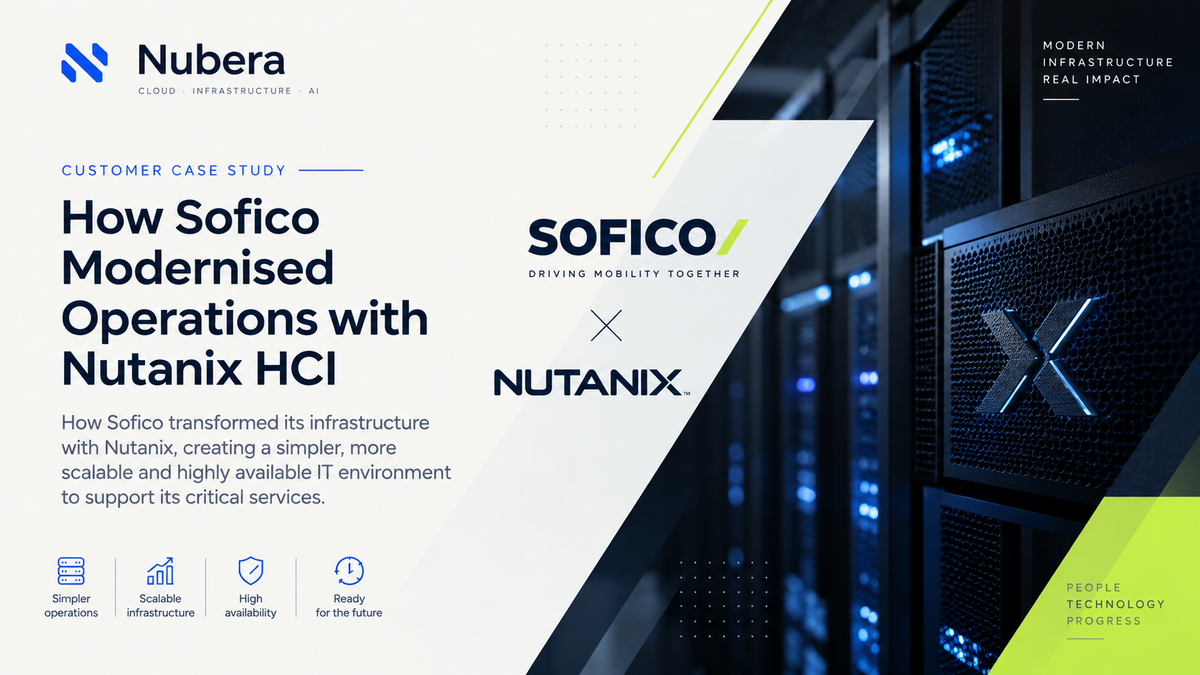
How Sofico Modernised Its IT Infrastructure with Nutanix HCI
How Sofico modernised its infrastructure with Nutanix HCI, creating a simpler, more scalable platform with automated updates and support for modern workloads.
As organisations grow, infrastructure that once worked well can gradually become a constraint.
For Sofico, a global provider of software solutions for the automotive finance and mobility industry, its existing datacenter infrastructure had reached that point. Increasing complexity made the environment more demanding to maintain, while downtime and lengthy update processes could affect operations across its international offices.
Sofico wanted a modern infrastructure platform that would simplify operations, reduce disruption and provide the flexibility needed for future workloads.
Nutanix HCI provided the foundation for that modernisation.
The challenge: modernising an increasingly complex environment
Sofico’s existing infrastructure required significant operational effort to maintain.
As the organisation and its global operations continued to develop, maintaining reliable services across different locations became increasingly important. Infrastructure downtime or complicated maintenance processes could have a direct impact on employees and the services they relied on.
Sofico therefore needed an infrastructure platform that could:
- Simplify day-to-day infrastructure management
- Reduce disruption during infrastructure maintenance and updates
- Improve reliability and performance
- Scale alongside future requirements
- Support modern workloads such as Kubernetes
- Introduce greater automation into infrastructure operations
Just as importantly, the transition needed to happen without unnecessarily disrupting the existing environment.
Choosing Nutanix HCI
Sofico selected Nutanix Hyperconverged Infrastructure as the foundation for its new environment.
By consolidating infrastructure resources onto a unified platform, Nutanix provided a simpler operational model compared with managing traditional infrastructure components separately.
Lifecycle management was another important consideration.
Updates that previously required significant operational planning could be handled through a more automated process, reducing the administrative effort associated with maintaining the underlying platform.
At the same time, the platform provided Sofico with the flexibility to support both traditional virtualised workloads and newer technologies such as Kubernetes.
Proving the platform before migration
Rather than moving directly into production, the project began with a Proof of Concept.
This allowed Sofico’s IT team to work with Nutanix in a realistic environment, validate the technology and understand how it would fit within their existing operational processes.
The PoC also provided an opportunity for the internal team to gain hands-on experience with the platform before the production implementation.
Once the architecture had been validated, the experience gained during the PoC helped streamline the transition into the production environment.
Automating infrastructure with Ansible
Infrastructure modernisation wasn’t limited to replacing hardware.
Automation formed an important part of the new operational model.
Ansible was used to automate configuration and make changes more consistent and repeatable. This reduced the amount of manual work required when configuring the environment and made it easier to apply changes when necessary.
Combining infrastructure automation with Nutanix’s own lifecycle management capabilities created an environment that required less manual intervention to operate and maintain.
Supporting Kubernetes on-premises
The new platform also provided Sofico with the ability to run Kubernetes clusters within its own infrastructure.
This gives the organisation greater flexibility in how applications and services are deployed.
Traditional virtual machines and modern containerised workloads don’t necessarily need completely separate infrastructure platforms. Instead, the underlying environment can provide a common foundation capable of supporting both.
For Sofico, this created a path towards adopting modern application architectures while continuing to make use of its on-premises infrastructure.
The outcome
Moving to Nutanix gave Sofico a more streamlined infrastructure platform designed around automation, availability and future growth.
The new environment provides:
- More automated infrastructure lifecycle management
- Reduced disruption associated with updates
- A simpler operational model
- Greater flexibility and scalability
- Support for on-premises Kubernetes
- Infrastructure automation using Ansible
- A platform capable of supporting future workloads
The project also gave Sofico’s internal IT team direct experience with the new platform through the Proof of Concept and implementation process.
Rather than simply replacing aging infrastructure, the project established a more flexible foundation for Sofico’s future IT requirements.
Modern infrastructure should simplify operations
Infrastructure modernisation shouldn’t introduce another layer of complexity.
A successful platform should make infrastructure easier to operate, automate repetitive processes and provide organisations with the flexibility to adopt new technologies as their requirements evolve.
Nutanix HCI provides a way to consolidate traditional infrastructure while creating a platform capable of supporting both virtual machines and modern application workloads.
Nubera helps organisations assess, design and implement Nutanix environments, from initial Proof of Concept through migration and ongoing operations.
Explore Nutanix with Nubera →